Index-antiguided waveguide lasers
Category: laser and resonator, quantum electronics, waveguide and fiber optoelectronic devices, photonic crystals, Bragg fibers.
Application: high-power laser, high-energy laser, large-mode-area laser
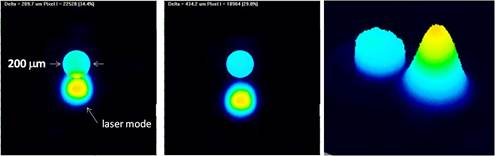
Gain-guided and Index-antiguided waveguide lasers support leaky modes that exhibit very different resonator characteristics from their conventional index-guided counterparts. For one thing, the large modal differential loss in IAG waveguides enables strong mode discrimination that favors single transverse mode (STM) operation, even for waveguide with very large mode area (LMA). This property lends itself as a promising platform for high-power or high-efficiency lasers. For another, resonator modes in open waveguides such as IAG waveguides in known to exhibit excess quantum noise, a property that could be exploited to yield lasers with controlled coherence properties.
Our group design and fabricate photonic bandgap fibers to achieve STM and LMA for laser radiation while simultaneously strong confinement of pump radiation. We also made the world-first demonstration of continuous-wave GG+IAG planar waveguide laser, fabricated using diffusion bonding by Northrop Grumman Synoptics in Charlotte.
Link to more details
Selected publication (see Publication for complete list)
- Tsinghua Her, “Gain-guiding in transverse grating waveguides for large modal area laser amplifiers,” Optics Express 16 (10) 7197-7202 (2008).
- Tsing-Hua Her, Xianyu Ao, and Lee W. Casperson, “Gain saturation in gain-guided slab waveguides with large-index antiguiding,” Optics Letters 34 (16) 2411-2413 (2009).
- Xianyu Ao, Tsing-Hua Her, and Lee W. Casperson, “Gain guiding in large-core Bragg fibers,” Optics Express 17 (25) 22666-22672 (2009).
- Chaofan Wang, Tsing-Hua Her, Lei Zhao, Xianyu Ao, Lee Casperson, Chih-Hsien Lai, Hung-Chun Chang, “Gain Saturation and Output Characteristics of Index-Antiguided Planar Waveguide Amplifiers with Homogeneous Broadening,” Journal of Lightwave Technology 29, p. 1958 (2011).
- Chaofan Wang, Tsing-Hua Her, Lee Casperson, “Power characteristics of homogeneously broadened index-antiguided waveguide lasers,” submitted to Optics Letters (2012).
More publication
Femtosecond-laser-induced periodic self-organized nanostructures (FLIPSON)

Category: femtosecond optics, directed self-assembly, photochemistry, laser-induced surface periodic structures.
Application: laser based nanofabrication, sub-wavelength optics.
Directed self-organization is to use external stimuli such as temperature, stress, electromagnetic fields, etc, to influence the global organization of constituent components in a deterministic fashion. In this work we have observed light as a driving force for DSO of tungsten atoms during laser chemical vapor deposition to form periodic nanostructures. This could lead to new fabrication schemes of large-area templates for data storage, catalysts, and sensors.
Link to more details
Selected publication (see Publication for complete list)
1. H. Zhang, M. Tang, J. McCoy, and T. Her, “Deposition of tungsten nanogratings induced by a single femtosecond laser beam,” Optics Express 15 5937 (2007).
2. Mingzhen Tang, Haitao Zhang, and Tsing-Hua Her, “Self-assembly of tunable and highly-uniform tungsten nanogratings induced by femtosecond laser with nanojoule energy,” Nanotechnology 18 (2007) 485304 (5pp).
3. Tsing-Hua Her, “Femtosecond-Laser-Induced Periodic Self-Organized Nanostructures,” appeared in Comprehensive Nanoscience and Technology, edited by David Andrews, Greg Scholes, and Gary Wiederrecht, published by Elsevier (Dec. 2010).
4. Haitao Zhang, Terry T. Xu, Mingzheng Tang, Tsing-Hua Her, and Shu-you Li, “Selective growth of tungsten oxide nanowires via a vapor-solid process,” J. Vacuum Science and Technology B 28 (2), pp. 310-315 (2010).