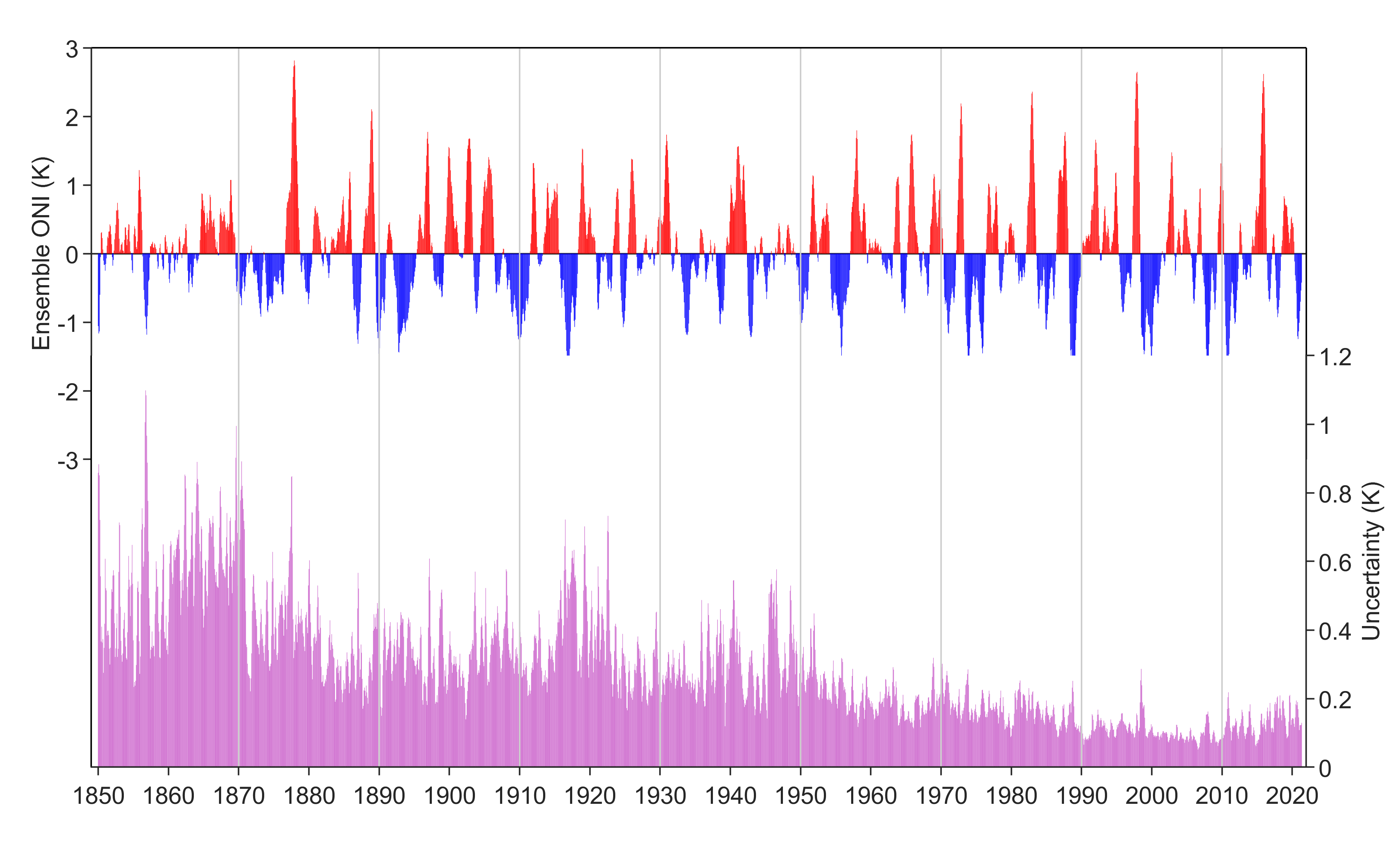
Figure from Webb and Magi 2022 (International Journal of Climatology) showing the state of the tropical Pacific Nino3.4 region and the uncertainty, both of which we calculated using an ensemble of 32 input datasets.
I’ll hopefully add more highlights of graduate student research related to climate but for now, check out work by my Masters student Eric Webb work on the Oceanic Nino Index Eric Webb’s Webberweather. Eric and I published part of his Masters Thesis (title “Reanalysis of the Extended Multivariate ENSO Index” in 2020) in a peer-reviewed paper titled “The Ensemble Oceanic Nino Index” in the International Journal of Climatology. The Abstract to our paper is below but click this link to get to the paper itself.
Abstract for “The Ensemble Oceanic Nino Index”: We describe a new El Niño–Southern Oscillation (ENSO) index that we call the Ensemble Oceanic Niño Index (Ensemble ONI). Ensemble ONI uses monthly sea surface temperature (SST) anomalies in the Niño3.4 region from 32 input SST datasets as the basis for the ensemble, and our new monthly ENSO index extends from the present back to the year 1850. We use the input datasets to quantify the uncertainty in the monthly index values. The uncertainty is calculated from datasets that are not completely independent from each other, but we use other estimates of uncertainty in SST, well-documented historical ENSO events, a detailed consideration of literature-based definitions of ENSO events, and proxy-based determinations of past ENSO events, to show that our uncertainty estimate from the ensemble of input datasets is comparable with other studies both in terms of average magnitude and the time-varying trend. Similar to past research, we find that ENSO events occur every 4–5 years on average, and there have been six “Super” El Niños (1877–1878, 1888–1889, 1972–1973, 1982–1983, 1997–1998, 2015–2016) that statistically rise above all other El Niños since 1850. Finally, the time span of our work shows that El Niño events were most intense at ends of both the 19th century and the 20th century, with a lull in the mid-1900s, corroborating previous instrumental, written, and proxy records.