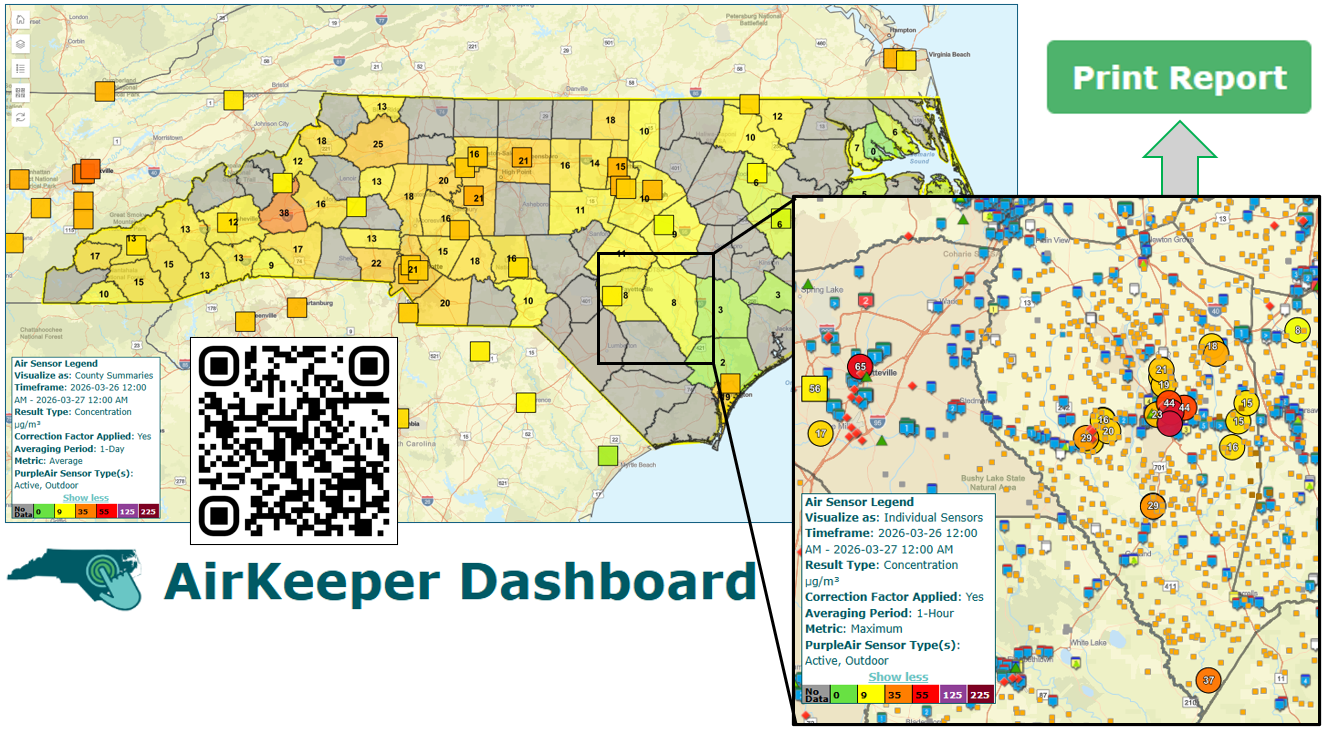
A glimpse of the CleanAIRE NC AirKeeper Dashboard. Visit the CleanAIRE NC AirKeeper Dashboard (AKD) for a much more interactive experience, or send me an email if you have questions.
The Clean Air Act guarantees everyone in the USA the right to breath clean air. The main regulated air pollutants still impacting the USA (and much of the world) are microscopic particles called PM2.5 and ozone gas. Exposure to both of these air pollutants as well as many others has substantially decreased over the last 40-50 years, but we are still learning about where the gaps are in terms of what the regulatory framework covers.
I am working at the interface of atmospheric chemistry, low-cost air monitoring instruments, and community-based efforts to study and hopefully overcome air pollution exposure disparities. I have worked with low-cost monitoring of ozone, CO2, VOCs, and other gaseous compounds/pollutants, but my main area of expertise centers on the aerosol particles that contribute to PM2.5. My PhD way-back-when was built around studying aerosol particles at regional scales, and I now mostly work at smaller spatial scales.
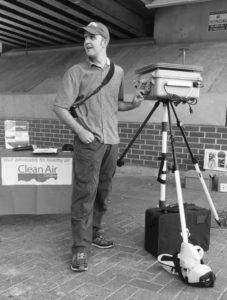
Sampling PM2.5 in downtown Charlotte using a “low-cost” air sensor.
A lot more air quality research is in the works right now too, but TBD in terms of getting it posted here. One example is that I am working with CleanAIRE NC on community-driven questions, and leading on much of the study design and the data analysis related to those efforts. Another example is that I am also working with medical experts to study the connection between health outcomes and air pollution in North Carolina that go beyond some of what the scientific communities already know about those linkages.
Send me an email if you have questions.