Announcements
- Charlotte Debate Team
- Debate Practices for Fall 2026 Tuesdays, 5:00pm Fretwell 219
- First Tournament is Online Friday & Saturday, September 25th-26th One-day tournament on Sunday, September 27th
- American Studies Minor
Plan for the Day
- Enlightenment Context
- Philosophy, Science, Invention
- J. Hector St. John. de Crèvecoeur “What is an American?”
- Democracy/Liberty/Freedom/ETC. quotation: “Cultivators of the earth are the most valuable citizens. They are the most vigorous, the most independent, the most virtuous, and they are tied to their country and wedded to its liberty and interests by the most lasting bands.” —Thomas Jefferson “Letter to John Jay,” 23 Aug 1785.
- John Jay, important Founding Father from New York; first Chief Justice of the Supreme Court.
Reading Matters
I am concerned that Americans are reading fewer books. As an English professor, curious person, and son of a librarian, I find it vital for engaged citizens and critical thinkers to read. I have told you that I have biases, and I will identify them–this is one of them. Reading helps you sustain attention to an argument. When you read a lot, you’re able to comprehend not just the words on the page but also meanings that are hidden, subtle, or perspectival. The more you read, in theory, the more curious you become, which leads to asking more effective questions. I’m not discounting that one can actively watch TV and films, but there’s more struggle in reading.
What’s special about the readings I assign is that they require delayed gratification. These readings will build on American principles related to democracy to help us better identify rhetorical strategies that reappear across our readings. I’m asking you to read for both content (Jefferson wrote, “…all men are created equal…”) as well as rhetorical techniques (Abigail Adams invokes divine plans to motivate Johns Adams to “Remember the Ladies”). This course is mandated because the State has an interest in your civic education, but I have an interest in your intellectual development, and these readings and the approach we’re taking serves both these purposes.
- What did these founders have in common?
- What give us a right to know?
Enlightenment Context
As mentioned last class on the first day, The Renaissance gave way to The Enlightenment in Western Civilization. This period is marked by scientific advancements and philosophical ideals that make up this “Age of Reason.” In this post-Scientific Revolution era, we see calls for rethinking and even dismantling traditional institutions, specifically Church and Monarchical State. Publishing was widespread, so people were reading about these thinkers and debating their merits. Some ideas that come out of the era are the following:
- classic liberalism: the state may not encroach on citizens’ rights or property without due process; the people are no longer merely subjects of a monarch.
- John Locke’s idea of the social contract needed to bind individuals together is relevant here.
- scientific revolution
- scientific method: creating knowledge through hypothesis, observation, and testing
- falsifiability: an experiment’s hypothesis is open to being not demonstrated* based on testing methods
- the public sphere: where ideas circulate among citizens
Brief History Lesson: The Public Sphere as Enlightenment Phenomenon
In the 18th century (the 1700s), pamphlets and newspapers circulated spreading ideas to the masses, who engaged in conversations (dare I say debates) about the topics. A starting point for an academic discussion of the public sphere comes from Jürgen Habermas, but that’s a bit beyond the scope of this class. For now, just consider that we’re reading documents from a revolutionary time. Think back to your history classes about the French Revolution (1789) or, perhaps, Les Misérables (“red….and black…”). You may remember the Estates General that “advised” the monarch:
- First Estate: Church/Clergy
- Second Estate: Nobility
- Third Estate: Peasants…(They’re revolting!)
Eventually, the Press would become known as the Fourth Estate, which supports Habermas’s idea that newspapers are important for forming “public opinion.” As feudalism and monarchy, in general, gave way to more representative, classical liberal forms of government, the public (citizens) deliberated on policy and elected representatives.
Below are some other definitions related to our Enlightenment discussion:
- objectivity: an unbiased approach to knowledge making, communicating, and deliberating.
- subjectivity: a more personal reference to “truth” based on one’s perspective and interpretation of phenomena.
- intersubjective: a group consensus of those with similar backgrounds and/or commitments to knowledge creation; sometimes called “expert opinion” in the case of specialized discourse communities.
- conventional wisdom: general assumptions of knowledge that are culturally defined (although not seen as culturally relative by adherents)
- common sense: pragmatic responses and decisions to events, including taken-for-granted socially constructed conventional wisdom.
- rationality: pursuing knowledge creation and communication based on convention and observable evidence.
- instrumental rationality: a means justifies the ends approach where one bases conclusions on what appears most pragmatic and, therefore, situationally advantageous. If a choice fulfills one’s ends, it’s situationally rational; however, assuming that’s the only way to think is rather myopic.
de Crèvecoeur’s “What is an American?”
The reason this piece is in the class is because it gives us some insight into the make up of the early Colonies. John Hector St. John. de Crèvecoeur is most likely embellishing the successes he finds, but it’s his message that is important. In addition to identifying the rhetorical techniques he uses and comparing them to other texts in class, we ought to think about the text as a place reproducing values. This socially constructed text gets published and re-presents the immigrant experience, especially the assumption of doing well for oneself. Beside this being a narrative in American culture today, it can help us understand motivations to engage with democracy and American culture. First, who was de Crèvecoeur?
- Born to wealthy parents in France (1735)
- Fought for the French in the French and Indian War
- Moved to New York and bought a farm in Chester, NY, northeast of New York City
- Returned to Europe and published Letters from an American Farmer in 1782
- This was a popular book and led to his being named a diplomat
- George Washington and Thomas Jefferson admired the book.
- Returned to the US to find his wife dead, children missing, and farm destroyed (1783)
- Published more books on America and, of course, wrote more letters
Guiding Questions for de Crèvecoeur
I have another webpage devoted to good ol’ Jean or John or James, so let’s consider these questions before jumping on over to “What is an American?”. His audience was Europeans, but colonists did read this book.
- What does de Crèvecoeur’s text communicate about civilization, especially European influence?
- What about education?
- As a farmer, the land is vital to de Crèvecoeur. What does he say about the land?
- How does he characterize the indigenous peoples?
- What are important values to him regarding hard work.
- What is his message about hard work and the land?
- This question is important because de Crèvecoeur has an assumption about usefulness and, ultimately, who gets to control the land.
Next Class
On Thursday, 9/3, we’ll be covering the Declaration of Independence, so read it before class. It’s short.
The Declaration of Independence
Plan for the Day
- Catch up on anything we missed Tuesday, 9/01
- Jefferson needed persuading to write the Declaration
- Drafting the Declaration of Independence (new page)
- Democracy/Liberty/Freedom/ETC. quotation: “That all men are by nature equally free and independent, and have certain inherent rights, of which, when they enter into a state of society, they cannot, by any compact, deprive or divest their posterity; namely, the enjoyment of life and liberty, with the means of acquiring and possessing property, and pursuing and obtaining happiness and safety.” —George Mason. Virginia Declaration of Rights. 12 June 1776.
More on Rhetoric
As mentioned last class, rhetoric is often associated with lying, deception, and political speech, but, time permitting, let’s discuss some more over on the Rhetoric Introduction page or, at least, discuss these major rhetorical appeals:
- logos: appeal to reason or logic
- ethos: the presentation of one’s character (usually to show the speaker/author is credible)
- pathos: appeal to emotions
In other rhetoric courses, we would go into further detail on these (and more rhetorical techniques), but the above definitions can be used to discuss The Declaration of Independence. For now, let’s consider these questions:
- How did Jefferson et al. justify severing ties with Great Britain?
- What ethos [credibility] did the writers (and signatories) want to convey?
- How does the Declaration characterize King George III?
Thomas Jefferson, et al.
The Declaration or Independence is the formal document that established (sure, not totally) the United States of America. Here’s a brief timeline of ratification. Also, Thomas Jefferson is the principle author of The Declaration, but Congress appointed four others: John Adams, Benjamin Franklin, Robert R. Livingston, and Roger Sherman. They had about three weeks to write, revise, and submit The Declaration to the Second Continental Congress. For more historical context, read up on the American Revolutionary War.
- People should be able to govern based on the consent of those governed (in fact, they are guaranteed this right by nature).
- After the preamble: notice the listing of abuses. There aren’t heavy details, but there are many abuses the writers point to for why the colonies ought to separate from Britain.
- In essence, the listing is a group of sound bites that can be used to gather support for rebellion.
- The Natives: notice the one group (besides the British) that the writers “call out” as particularly aggressive. They seem like…
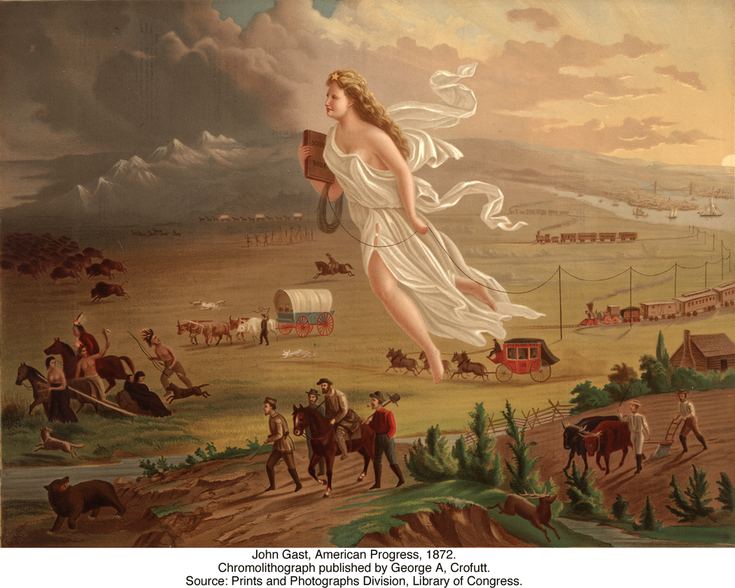
Whenever the Declaration of Independence is referred to, the main focus is on the beginning paragraphs: “When in the Course of human events…” and “We hold these truths to be self-evident, that all men are created equal…” Often, this John Gast painting is discussed.
Key concepts
- Natural rights
- Tyranny (an antonym of democracy)
- Government made legitimate by the “consent of the governed”
Significance
The Declaration of Independence, whose lead author was Thomas Jefferson, takes the form of a substantial (1,300-word) open declaration, addressed implicitly to a global audience. Much of the document consists of a long list of grievances, but the document is bookended by first and last paragraphs that announce the colonies’ separation from the British Empire.
The best-known part of the document is the long second paragraph, which contains well-remembered phrases, including “all men are created equal.” The historian David Armitage has called the Declaration “an announcement in the form of an argument,” which was the first in what became a “global genre” of political writing (Armitage 26, 16).
Armitage, David. The Declaration of Independence: A Global History. Harvard UP, 2007.
Structure
- First paragraph: Explains the need to “declare the causes” for separation from Britain
- “unanimous Declaration”
- “Laws of Nature and of Nature’s God”
- “a decent respect to the opinions of mankind requires that they should declare the causes which impel them to the separation.”
- Second paragraph: Appeals to natural rights and contains the famous phrases, including “all men are created equal”
- “Governments are instituted among Men, deriving their just powers from the consent of the governed“
- How was Great Britain’s monarchy legitimized?
- “That whenever any Form of Government becomes destructive of these ends, it is the Right of the People to alter or to abolish it, and to institute new Government…”
- Well-thought-out declaration–not spur of the moment
- Colonists suffered longer than they should have: “the patient sufferance of these Colonies”
- “Governments are instituted among Men, deriving their just powers from the consent of the governed“
- Middle section: Lists grievances against King George III, including: EVIDENCE
- Dissolution of colonial legislatures
- Impeding the rule of law
- “Imposing taxes on us without our Consent”
- Final paragraphs: Declares the colonies to be “FREE AND INDEPENDENT STATES”
- “A Prince, whose character is thus marked by every act which may define a Tyrant, is unfit to be the ruler of a free people.”
- “the ties of our common kindred”…”They too have been deaf to the voice of justice and of consanguinity”
- “appealing to the Supreme Judge of the world…in the Name, and by Authority of the good People of these Colonies”
- “divine Providence, we mutually pledge to each other our Lives, our Fortunes and our sacred Honor.”
Questions for Our Rhetorical Approach
As mentioned, we privilege a rhetorical (as opposed to privileging–not ignoring–a historical or political science) approach to these texts; therefore, I have to ask, in addition to the obvious declaration, what does the Declaration of Independence do?
- What other genre of writing does this remind you of?
- Consider the audiences
- Primary
- Secondary
- Tertiary
- Can you identify a prevailing or major appeal? To what or who?
Consider Jefferson’s Earlier Draft: Drafting the Declaration of Independence.
Next Week
On Tuesday, 9/8, we’ll finish up anything from this week and move onto the short letters of Abigail Adams and John Adams “Remember the Ladies” (March 31 & April 5, 1776) and Despotism of the Peticoat” (April 14, 1776). Both are on Canvas. Next Thursday, 9/10, we won’t meet as a class, but you’ll do TEST #1 on Canvas wherever you have internet access.